#accessibility The image shows a mouth with red lipstick biting a red pepper.
Text written by collaborator Igor Espindola de Almeida
Running away from everything that causes pain can be clear for most people, however, some cases, like physical exercises, a spicy dish, or a relationship argument, can show us that pleasure and pain can be found side by side in human nature.
Pain is something that our body understands with a high degree of urgency. This occurs because usually if something is causing you pain, it’s because it can damage you: high temperatures, extremely low temperatures, a bite, electric discharges, and the list of dangers goes on. But how do you know that you are feeling pain?
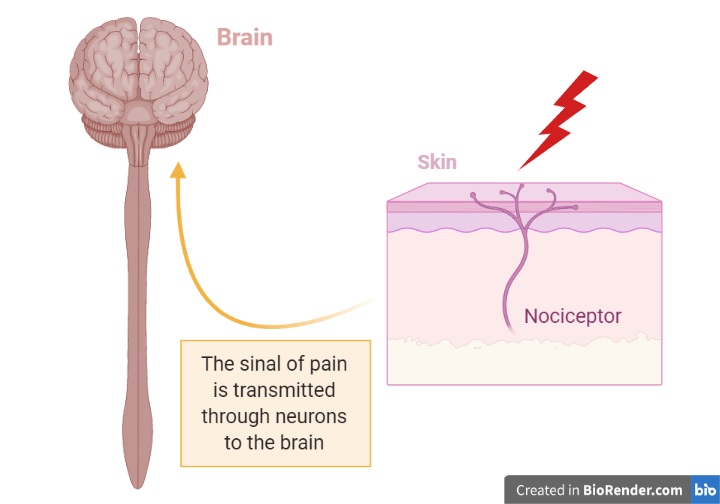 Think you’re a soldier responsible for a submarine’s radar. On the radar there is a missile that is coming towards you. Like a good soldier, you warn the other soldiers and ask for their help to send the captain a message about it. The remaining soldiers inform the captain who activates the alarm and prepares a strategy to defend or neutralize the danger.
Inside our body, you’d be what we call nociceptor, a type of cell in our skin that registers dangerous factors (such as temperature) that are affecting us. Linked to our nociceptors there are neurons, nervous-system cells that use electric signals to communicate with each other. When something is wrong, the nociceptors stimulate the neurons to which they are connected, “warning them” of problems and that this information needs to be transmitted to “the captain”: the brain. The information is transmitted by one neuron to the other, leaving your skin till your spine, then it goes up and reaches brain neurons, where the information is processed. It’s at this moment you understand that something is causing you pain. Once its origins are noticed and identified, one strategy is going to be created to stop the pain unless the person likes it. This “like” is caused by a biological relation.
When the brain detects the pain, one of its parts called the pituitary gland, responsible for secreting substances into the bloodstream, releases the hormone endorphin, which relieves the pain, so that it can become bearable enough, for the brain to strategize ways to stop it. Endorphin, nevertheless, is also released in pleasant activities, such as eating a chocolate bar.
Another good example is physical exercise. Although you spend energy while you exercise, and you are probably feeling pain, endorphins cause a feeling of well being. The same happens when we eat some type of pepper, the spicy flavour is also a result of receptors in our tongue that process the pain.
The similarities aren’t limited to only physical sensations. Another molecule present in our brain’s functioning, the oxytocin, often associated with empathy and positive social relations, has been said to be present when a partner presents contempt of some sort. This oxytocin release makes the neglected partner try to get emotionally closer to the other in order to maintain the relationship. So, the adequacy of limits of pain tolerance has promoted several kinds of experiences to human-beings, some pleasant others not.
Translation by Igor Espindola de Almeida (author) and Mariza Araki
Sources:
Featured image source: Image from englishlikeanative by Pixabay
Image 1 source 1: Author
BEAR, M. Desvendando o Sistema Nervoso, 3 Ed., 2008.
NEHLIG A. The neuroprotective effects of cocoa flavanol and its influence on cognitive performance. Br J Clin Pharmacol. 2013; 75(3):716-727. Disponível em: https://www.ncbi.nlm.nih.gov/pmc/articles/PMC3575938/
BOSLAND PW. Hot stuff – do people living in hot climates like their food spicy hot or not?. Temperature (Austin). 2016;3(1):41-42. Published 2016 Jan 29. Disponível em: https://www.ncbi.nlm.nih.gov/pmc/articles/PMC4861186/
GREBE, N. Oxytocin and vulnerable romantic relationships. Hormones and behavior. Hormones and behaviour 90. Fevereiro, 2017. Disponível em: https://www.researchgate.net/publication/314227000_Oxytocin_and_vulnerable_romantic_relationships
Learn more:
Podcast – Jornal da USP – Exercícios de alta e de média intensidade liberam maior quantidade de endorfina
Other disseminators:
https://www.nanocell.org.br/o-que-e-dor/ – Jornal
TED-Ed – Youtube
Clash Course – Youtube